
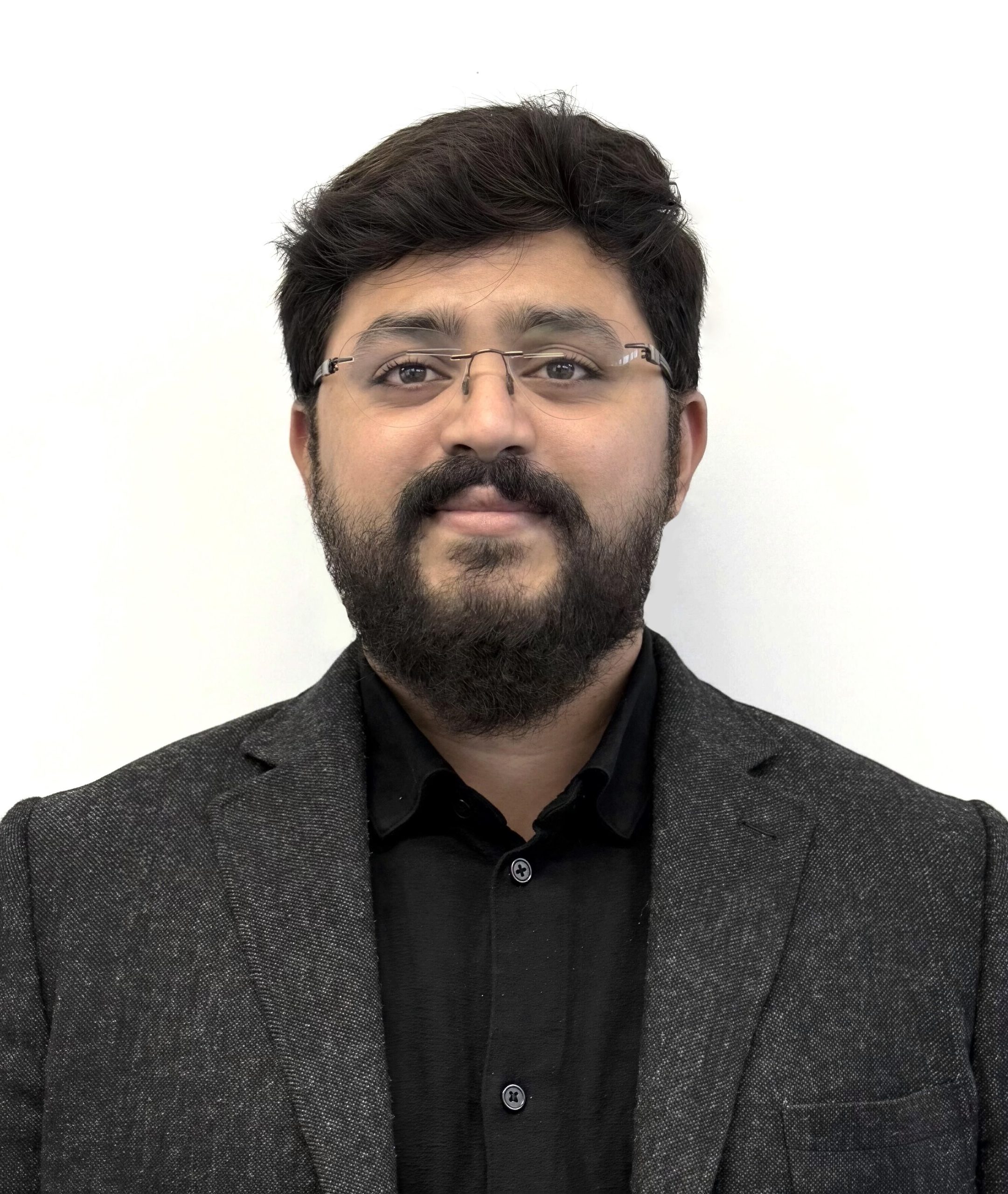
Dr Vivek Kumar
ROSETTA Project:“ADAPT-AI: ADAPTive, Domain-Aware and Responsible Multimodal Generative AI”
Supervisor: Prof Ashish Kumar Jha
Host University: Trinity College Dublin
Email: kumarv4@tcd.ie
LinkedIn: https://www.linkedin.com/in/vivek-kumar-phd-44011683/
ORCID ID: 0000-0003-3958-4704
Dr Vivek Kumar is a ROSETTA postdoctoral fellow with Trinity College Dublin. He is undertaking his fellowship under the supervision of Prof Ashish Kumar Jha.
Vivek is a computer scientist whose research tackles two persistent obstacles to trustworthy AI in sensitive fields: domain adaptation, which means making general-purpose models work reliably in a specialised field, and scarce data. He earned his doctorate in 2023 as a Marie Skłodowska-Curie Fellow in the EU Horizon 2020 PhilHumans network at Philips Research and the University of Cagliari. There he developed K-LM, a method for knowledge-augmented domain adaptation, and co-created AnnoMI, an open dataset of expert-annotated counselling conversations. His recent work applies generative AI to psychotherapy, where it addresses inherent bias, semantic drift and false semantic change, in which generated text quietly departs from the original meaning. He previously coordinated the Horizon Europe project STELAR as a Senior Researcher at the University of the Federal Armed Forces Munich. Earlier, he worked as a Research Engineer on CERN’s Search for Hidden Particles (SHiP) experiment.
Beyond research, Vivek is committed to bringing AI into real-world mental health practice. He leads Behavioural AI research at ManoRaksha, a multidisciplinary mental health organisation that brings together psychologists, clinicians and AI scientists. He is a Senior Member of IEEE and a Fellow of the Soft Computing Research Society and serves as a reviewer for leading AI conferences and journals. He is also a regular keynote and invited speaker on knowledge-augmented and safe AI. Through his interdisciplinary work, bridging language technology, psychology and clinical practice, Vivek continues to advance safer and more empathetic AI for mental health care.
Large language models, the technology behind tools (Claude, ChatGPT, Mistral, etc.,) are increasingly used in sensitive, people-facing settings. But they tend to hallucinate, carry cultural and linguistic biases and lose meaning over the course of a conversation. In mental health support, where reliable data is scarce, a single inaccurate or culturally insensitive response can cause real harm.
Vivek’s ROSETTA project, titled “ADAPT-AI: ADAPTive, Domain-Aware and Responsible Multimodal Generative AI”, aims to make generative AI more reliable, fair and transparent in mental health support. It will develop novel knowledge-injection methods that enrich language models with structured domain knowledge from knowledge graphs. Alongside these, it will build metrics that quantify the threshold beyond which injected knowledge becomes knowledge noise and distorts meaning. It will also introduce evaluation protocols that combine automated and expert human assessment to measure factual consistency, bias, hallucination and semantic drift across languages and modalities. These advances will come together in an agentic AI system that retrieves domain-grounded evidence, then verifies and explains its own responses, with a human in the loop and every decision traceable. The project draws on the host’s strengths in business analytics and information systems research, and its methods, data and tools will be shared openly to support trustworthy, human-centred AI in mental health and other high-stakes fields.