
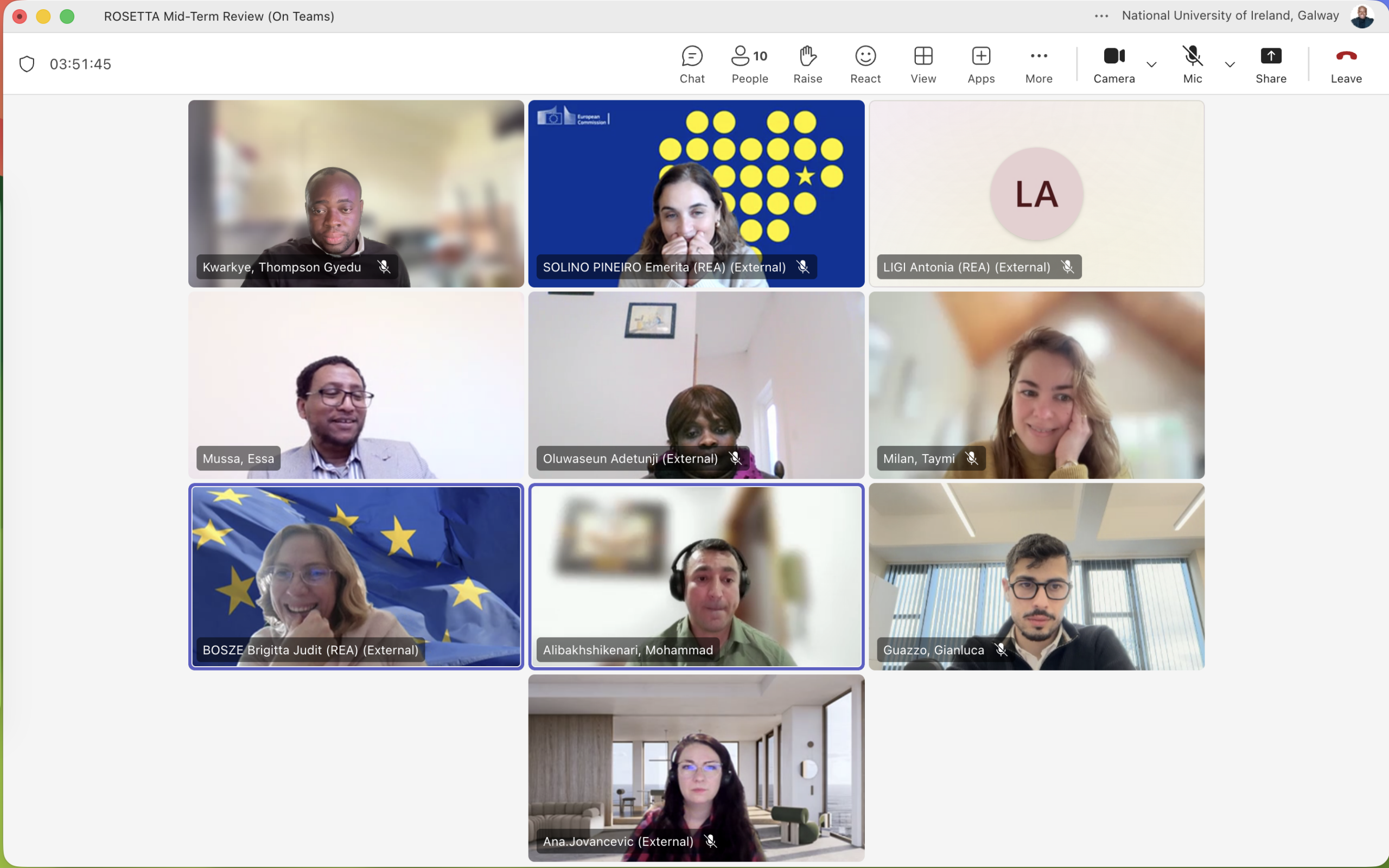
The ROSETTA Mid-Term Review took place on 4 February 2026, marking an important milestone for the fellowship programme focused on the theme of Time and Responsible Technology. Coordinated by Professor Kieran Conboy and Project Manager, Emma Brinton, the event brought together representatives from the European Research Executive Agency (REA), including Brigitta Judit Bosze, Emerita Solino Pineiro and Antonia Liga, alongside principal investigators and ROSETTA fellows from the University of Galway and the University of Limerick.
The review highlighted the strength of ROSETTA whose aim is to train and develop the next generation of European leaders to understand and evaluate the complex relationship between time and technology. The programme is currently recruiting 19 postdoctoral fellows, who will receive advanced training in cutting-edge theories and research methodologies. These fellows will critically examine how technology is developed, used, and regulated through a time lens—addressing its impact across diverse domains, including childhood, disability, workplace practices, healthcare, and social inclusion for older adults.
ROSETTA’s structured two-year fellowship programme combines cutting-edge research with training in entrepreneurship, communication, and career development. Secondments enable fellows to undertake placements in academic or non-academic sectors tailored to their research objectives and career development.
Supported under Horizon Europe, Lero, the Research Ireland Centre for Software and the College of Business, Public Policy and Law at University of Galway, the ROSETTA research portfolio spans a diverse range of impactful themes, including AI governance in Africa, the role of time in digital whistleblowing systems, the application of AI across children and ageing populations, climate change impacts in rural communities, and a number of additional emerging projects.
This project has received €3.5M funding from the European Union’s Horizon Europe Marie Sklodowska-Curie Actions under Grant Agreement No 101126578 and in part from Lero, the Research Ireland Centre for Software [under Grant Reference 13/RC/2094_2].